Saint-Jacques Chapel
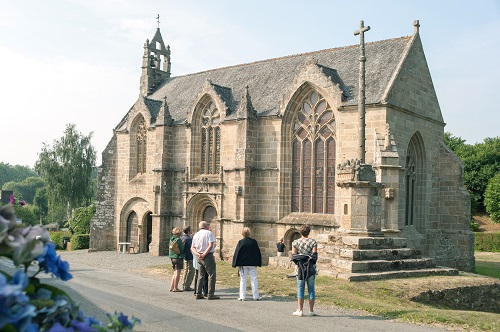
A medieval chapel that has been altered several times, notably in the 16th and 19th centuries (when the roof was raised). There are several theories regarding the origin of this chapel, which may have been built either by the Knights Hospitaller of St John of Jerusalem, the canons of Beauport Abbey, or the local lords of Coat Men.
This chapel lies on the route of several pilgrimage routes: the Way of St James, starting from Beauport, and the Tro Breizh route. The chapel’s imposing size may be explained by the donations – surely numerous – from visitors and pilgrims.
Situated on the Roman road linking Saint-Brieuc to Lannion, Tréméven and the Chapel of Saint James have, throughout the ages, been a hub of trade and commerce. In the Middle Ages, the grain market was held every week, and the great fair every quarter. This chapel was also the place where the lords of Coat Men administered justice, the right to do so having been entrusted to the local lords. The links between the nobles" judicial power and the Church are significant; royal justice and the person of the king, for example, were intimately linked to God.
The chapel’s exterior façade is striking for its asymmetry. From left to right, the doors become narrower whilst the windows and stained-glass panes grow larger. This is due to the numerous renovations and reconstructions carried out over the centuries. The larger, airier and more intricately crafted the openings are, the closer we get to our own era (the transition from the Romanesque to the Gothic style in the late 11th–early 12th centuries). The third, smaller door is carved with a depiction of Saint James the Pilgrim, surmounted by a scallop shell.
The first restoration took place in 1562, the second in 1723. Finally, in 1876, a final renovation was carried out thanks to the support of numerous donors.
On the other side of the chapel, the wall reveals several chapters of history. One can see the numerous stonemasons" marks – impressions left in the stone by the stonemasons. These craftsmen ‘signed’ their work both for accounting purposes and for identification. On this side, the various extensions are visible: the difference in the materials used is clearly evident. Of note is the filling in of a former wing which, according to accounts, was destroyed around 1830.
Additional features: it houses a 15th-century female head, a statue of Saint Anne of the Trinity (listed as a historic monument), a statue of Christ in bonds, an early 17th-century statue of Saint Roch, and a 17th-century statue of Saint Nicholas and Saint Gilles with his dog. The altar and altarpiece date from the late 17th to early 18th century. Its porch is made of granite and a calvary stands on the chapel’s churchyard. A fountain dating from the early 16th century is listed as a historic monument.
If the chaplain is absent, a sign next to the chapel door indicates where to collect the key to visit the chapel at your leisure. Free of charge.